Robotics Is on a Path Toward a $25 Trillion Economy
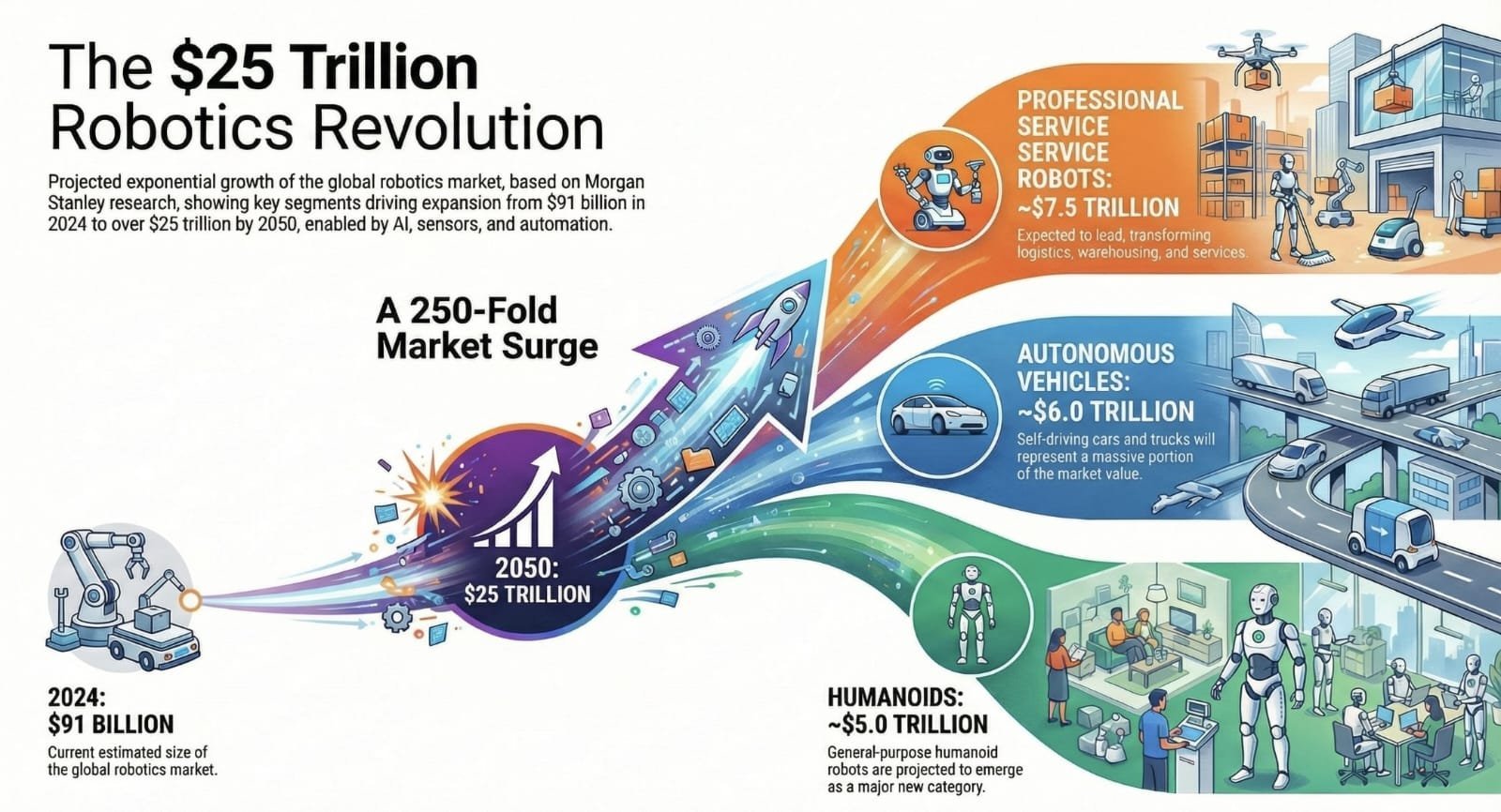
Morgan Stanley projects that robotics will expand from a $91 billion global market today to an astonishing $25 trillion by 2050. That kind of trajectory would place robotics among the largest sectors on Earth, rivaling entire national economies.
What makes this forecast believable is not hype, but adoption patterns that are already visible in the real world. Global robot installations have been growing at a compound annual rate of roughly 13 percent since 2015, which shows steady and durable progress rather than a bubble. Logistics automation spending continues to climb more than 20 percent per year, driven by e-commerce, labor shortages, and the rising cost of inefficiency.
Inside warehouses, robots are no longer futuristic gadgets. Facilities that have deployed automated systems report productivity gains in the range of 25 to 30 percent. That translates to faster fulfillment, fewer errors, and higher throughput, which directly improves margins in industries where speed is everything.
If this trend continues, robotics will not be confined to manufacturing plants or high-budget logistics hubs. Lower hardware costs, better sensors, and increasingly capable AI models are pushing robots into new environments. That includes construction sites, retail, agriculture, and eventually homes.
A $25 trillion future is not just about robots replacing repetitive labor. It is about reshaping the global economy, rewriting the cost structure of goods, and changing how businesses think about growth.
The world is on the cusp of treating robotics as a foundational technology category rather than a niche. The companies investing in automation today are positioning themselves not for small efficiency gains, but for a transformation that will define the next generation of industry.