
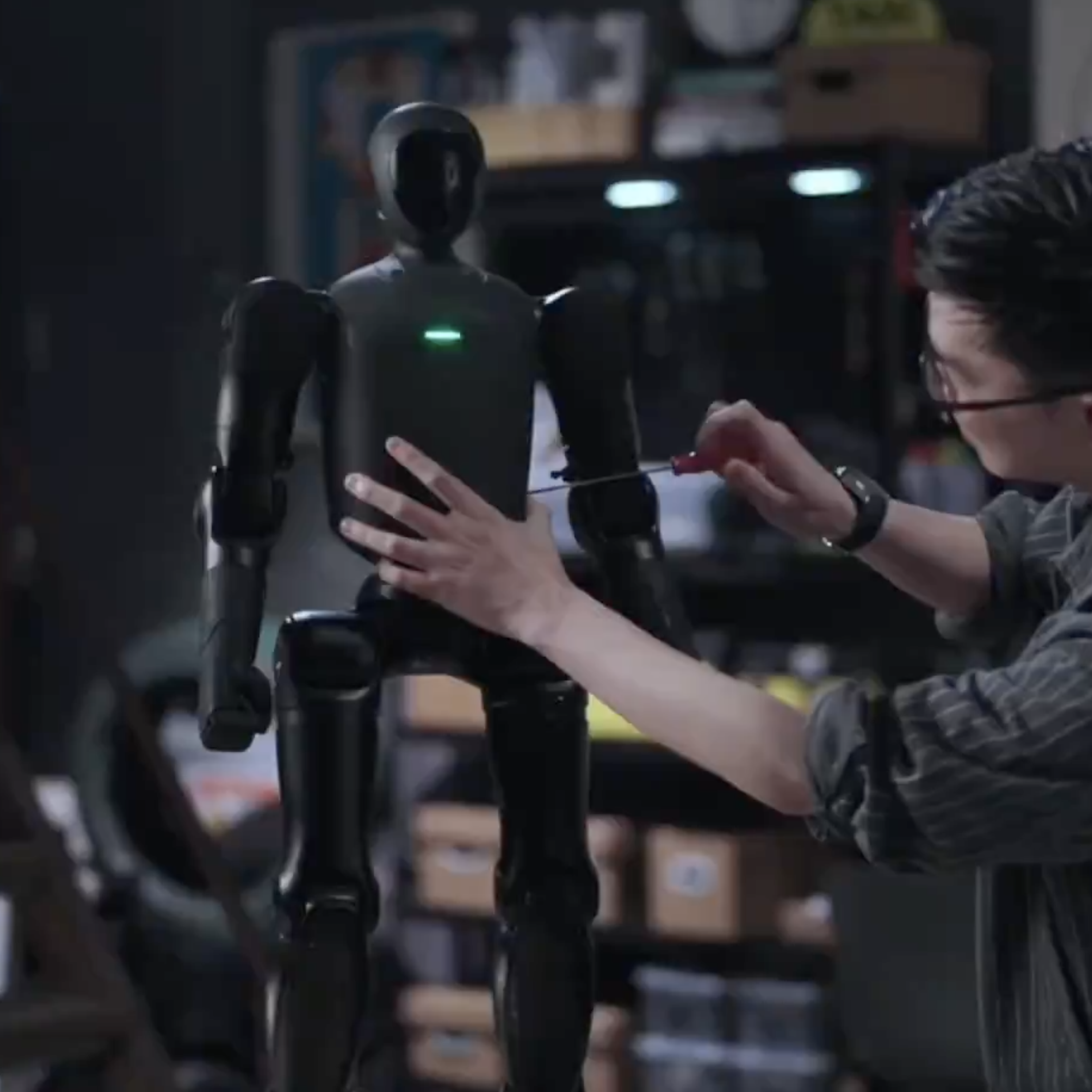
AGIBOT Unveils the Q1 Mini Humanoid and Signals the Rise of In Home Robots
The era of personal humanoids has quietly crossed a threshold. With the unveiling of the Q1, AGIBOT has introduced a robot that feels less like a lab-bound prototype and more like a personal device. At just 0.8 meters tall and small enough to fit inside a standard backpack, the Q1 redefines what a capable humanoid can look like.
The announcement comes from AGIBOT co-founder and renowned developer Zhihui Jun, known for turning ambitious robotics ideas into working systems. The Q1 is not a novelty or a scaled-down demo. It is a full-stack humanoid platform built to push experimentation, creativity, and everyday interaction into a form factor that feels approachable for individuals rather than institutions.

AGIBOT’s “Nezha” Robot Blurs the Line Between Walking and Rolling — And It Might Be the Future of Smart Mobility
In the ever-evolving world of humanoid robotics, Shanghai-based AGIBOT (Zhiyuan) is making headlines with a breakthrough that could redefine how robots interact with real-world environments. Their latest innovation, “Nezha,” is a new-generation humanoid robot capable of seamlessly transitioning between walking on two legs and rolling on two wheels — all autonomously, based on situational awareness.

AGIBOT and Pi Join Forces to Unlock Multimodal Embodied Intelligence in HouseBots
In a major move set to reshape the landscape of humanoid robotics, Chinese robotics firm AGIBOT has announced a strategic collaboration with Pi, a frontier artificial intelligence company, to pioneer the development of multimodal embodied intelligence. The partnership centers on leveraging VLA (Vision-Language-Action) architectures, enabling humanoid robots to autonomously complete complex, real-world life tasks with minimal human intervention.